Motorcycle lane splitting – also referred to as “lane sharing” is one of the most debated traffic practices involving motorcycles in the US. From a liability and regulatory standpoint, the legal treatment of lane splitting varies dramatically across jurisdictions. Nowhere is that contrast more pronounced than in California, which stands alone in expressly legalizing the practice.
This article examines California’s statutory framework governing lane splitting and contrasts it with how other states regulate—or prohibit—the same conduct.
What is Splitting Lanes?
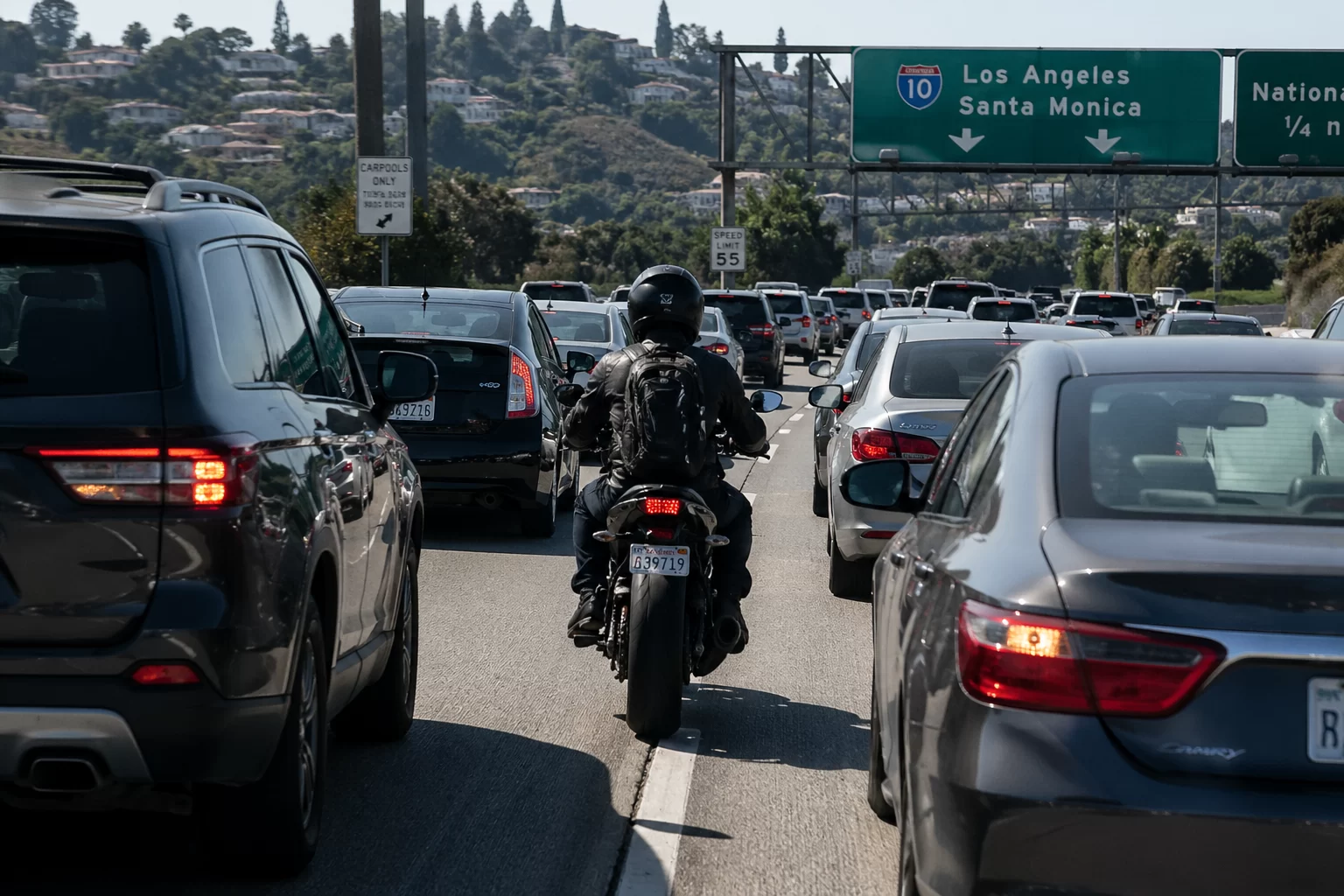
Lane splitting occurs when a motorcyclist rides between lanes of stopped or slow-moving vehicles traveling in the same direction. Under California law, this definition is codified and explicitly recognized.
California’s Legal Framework
California is the only U.S. jurisdiction where lane splitting is expressly legal by statute. The governing law is California Vehicle Code § 21658.1, enacted through Assembly Bill 51 and effective January 1, 2017.
California Vehicle Code § 21658.1 General Summary:
California Vehicle Code § 21658.1 makes lane splitting legal for motorcycles in California. The law defines lane splitting as riding a motorcycle with two wheels on the ground between rows of stopped or moving vehicles traveling in the same direction, whether on a divided or undivided street, road, or highway. The statute also authorizes the California Highway Patrol (CHP) to develop educational guidelines relating to safe lane splitting practices. However, the law does not establish a specific speed limit or detailed rules for when lane splitting is permitted, meaning motorcyclists must still operate their motorcycles safely and comply with general traffic laws. As a result, although lane splitting itself is legal, a rider can still be found at fault or cited if the maneuver is performed in an unsafe or reckless manner.
Key Legal Elements
- Explicit legality: Motorcyclists may ride between lanes of traffic moving in the same direction.
- Applicability: The law applies to multi-lane roads, including highways and city streets.
- No fixed speed limits in statute: The statute does not define precise speed thresholds.
- “Safe and prudent” standard: Riders must operate under California’s general negligence framework, particularly the Basic Speed Law.
Splitting Lanes Near Semi Trucks
Lane splitting becomes exponentially more dangerous when motorcycles pass between lanes of traffic that include semi trucks. Due to their large size and height, semi trucks have massive blind spots on all sides, including directly alongside the trailer. Truck drivers often cannot see a motorcycle approaching or traveling alongside them, increasing the risk of a catastrophic collision if the truck changes lanes or makes a turn.
Additionally, the turbulence created by a passing semi can destabilize a motorcycle, and the very narrow space between a truck and other vehicles leaves little room for error. Even experienced riders face significant dangers when lane splitting near large commercial vehicles. If you or a family member has been injured by a semi truck while legally splitting lanes, contact one of the best truck accident lawyers in California.
Role of the California Highway Patrol (CHP)
The statute delegates authority to the CHP to develop safety guidelines. These include:
- Limiting speed differentials (generally recommended ≤10 mph faster than traffic)
- Avoiding lane splitting when traffic exceeds approximately 30 mph
Although these guidelines are not statutory mandates, they are frequently used in litigation to evaluate reasonableness and comparative fault.
Liability Implications
California follows a pure comparative negligence system. In lane-splitting accidents:
- A driver may be liable for unsafe lane changes or failure to signal.
- A motorcyclist may share fault if splitting at unsafe speeds or conditions.
This creates a fact-intensive liability analysis—particularly relevant in commercial truck accident cases where visibility and blind spots are central issues.
How Other States Treat Lane Splitting
1. States Where Lane Splitting Is Illegal
The majority of U.S. states prohibit lane splitting, either explicitly or through enforcement of general lane-use statutes.
- Most states require vehicles to remain within a single lane.
- Law enforcement typically cites riders for unsafe passing or reckless driving.
In these jurisdictions, a motorcyclist who attempts lane splitting may be presumed negligent or in violation of traffic law, significantly impacting civil liability.
2. States Allowing Limited “Lane Filtering”
A growing number of states distinguish between lane splitting and lane filtering:
- Lane filtering: Riding between vehicles only when traffic is stopped or nearly stopped
- Typically subject to strict conditions (low speeds, limited road types)
Examples include:
- Utah (legalized filtering in 2019)
- Montana (legalized filtering in 2021)
- Arizona (legalized filtering in 2022)
- Colorado (legalized filtering in 2024)
- Minnesota (legalized filtering in 2025)
These laws generally:
- Restrict filtering to stopped traffic
- Impose speed caps (often 15–25 mph or lower)
- Limit applicability to roads with specific speed limits
Legal Significance
Unlike California:
- These states do not allow full-speed lane splitting in moving traffic.
- Violations can still expose riders to negligence per se arguments.
3. States With No Explicit Law (Gray Areas)
Some states lack statutes specifically addressing lane splitting. However:
- Officers rely on general traffic laws (e.g., improper lane usage, unsafe passing).
- Courts often interpret lane splitting as unlawful or negligent behavior.
Key Legal Differences: California vs. Other States
| ISSUE | IN CALIFORNIA | MOST OTHER STATES | FILTERING STATES |
|---|---|---|---|
| LEGAL OR ILLEGAL? | Explicitly legal | Generally illegal | Limited legality |
| TRAFFIC CONDITIONS | Moving or stopped traffic | Not permitted | Typically stopped traffic only |
| STATUTORY CLARITY | Codified in §21658.1 | Often indirect or absent | Narrow statutory exceptions |
| LIABILITY IMPACT | Comparative fault analysis | Likely rider negligence | Conditional liability |
| REGULATORY GUIDANCE | CHP guidelines | Minimal or none | Statutory restrictions |
Implications for Truck Accident Litigation
Lane splitting introduces complex liability dynamics in commercial vehicle cases:
In California
- Truck drivers must anticipate lane-splitting motorcycles, especially in congested traffic.
- Failure to check blind spots or signal lane changes can result in significant liability.
- Defense arguments often focus on whether the motorcyclist acted “reasonably.”
Outside California
- Motorcyclists engaging in lane splitting may be deemed in violation of traffic laws, strengthening defense arguments.
- Comparative fault may heavily favor the truck driver.
Policy Considerations
California’s approach is often justified by:
- Reduced rear-end collisions involving motorcycles
- Improved traffic flow in congested corridors
However, critics argue:
- Increased unpredictability for drivers
- Heightened risk in mixed traffic environments, especially with large commercial vehicles
Other states have opted for incremental adoption via lane filtering, reflecting a more conservative regulatory approach.
Conclusion
California remains the only state with full statutory authorization of motorcycle lane splitting, creating a distinct legal landscape compared to the rest of the country. While several states have begun adopting limited lane filtering laws, most jurisdictions continue to prohibit the practice outright.
For attorneys handling motorcycle or truck accident cases, understanding these jurisdictional differences is critical. Liability exposure, negligence analysis, and litigation strategy can shift dramatically depending on whether lane splitting is lawful, restricted, or prohibited in the relevant state.