
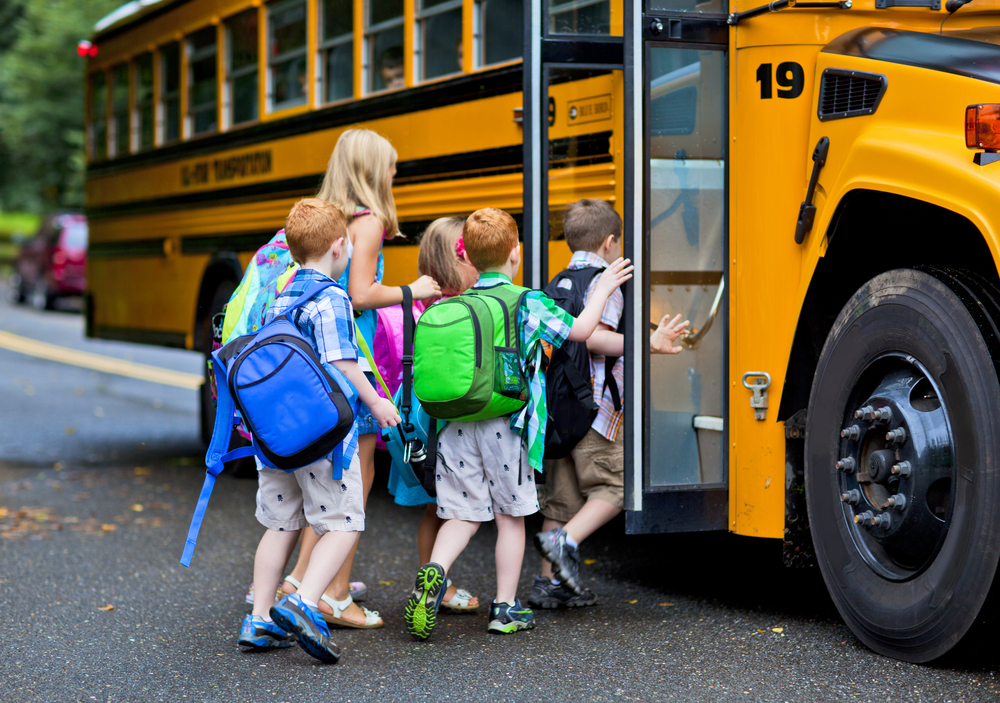
Seat belt regulations on school buses vary across the United States. While some states have enacted laws requiring them, the majority still do not mandate seat belts on all school buses. Despite professional driver training, fatal accidents continue to occur, prompting discussions around seat belt implementation.
The National Highway Transport Safety Administration (NHTSA) has found that nearly six students die in school bus crashes every year in the US. From the years 2006 to 2015, more than 54 students have been killed in school-transportation vehicles. Though school bus drivers must complete comprehensive testing to drive a school bus, a lot of these fatalities could have been prevented if the school buses simply had seat belts.
To make the school buses safer, seat belts were made a legal requirement in some states. However, most states have not passed any legislation for mandatory seat belts on school buses. In this post, we will look at the type of seat bus belt laws in different states and what schools have done to conform to the legal requirements.
Federal School Bus Seat Belt Laws
 The federal government has given the authority of setting safety standards for school buses to NHTSA. The agency previously considered seat belts to be unnecessary on large school buses. The seat belts were required only on small school buses weighing less than 10,000 pounds.
Initially, the National Highway Traffic Safety Administration (NHTSA) required seat belts only on small buses under 10,000 pounds, citing cost and seating capacity as concerns. In 2015, the agency reversed its stance, supporting seat belts on all school buses under Federal Regulation 49 C.F.R. § 571.222.
However, after a string of accidents involving school buses, the authority announced in 2015 that seat belts should be made mandatory in every school bus.
The NHTSA regulation 49 C.F.R. § 571.222 states that school bus seat belts can reduce the severity of injuries and fatalities due to a collision.
States School Bus Seat Belt Laws
As of 2019, eight states—California, Florida, Texas, New York, New Jersey, Louisiana, Arkansas, and Nevada—require seat belts on school buses. However, many of these laws are conditional, depending on available funding. In some states, such as New York, local districts decide whether students must wear the belts, while New Jersey mandates their use.
But if we look at the fine print of the seat belt legislation, it becomes clear that in most states the seat belts are required only if required funding is available to the school.
Also, students aren’t legally required to wear seatbelts in some states. For instance, in the state of New York, seatbelts are required on all buses made after July 1987. However, each school district needs to decide whether actually wearing the seatbelts is necessary.
In contrast, New Jersey law requires all students to wear seat belts. The school has to pay a penalty if students are not found wearing seat belts on school buses.
Lap Seat Belts and Shoulder Seat Belts
Not all states have the same requirements for seat belts. Some states require lap while others require lap and shoulder seat belts.
However, studies have shown that lap belts can result in injuries. Lap-only seat belts have been associated with injuries such as spinal fractures, abdominal trauma, and head injuries. This condition, known as “Seat Belt Syndrome,” results from the body jackknifing over the belt during impact. Experts recommend three-point seat belts for better restraint and injury prevention. The injuries included:
-
Fractures of the Lumber Spine
-
Severe Abdominal Injuries
-
Head injuries
The injuries occurred due to the body jackknifing at the wait over the lap belt in the event of a collision. Wearing the lap seat belt results in the high force applied to the waist region. Securing the lap region without securing the shoulder and head results in high neck and head velocities leading to serious injuries. These serious injuries can be prevented by wearing a three-point belt system.
At the present, Florida, New Jersey, New York and Louisiana require lap only seat belts. However, the NHTSA has recommended in 2018 that states should update the legislations by mandating three-point seat belts on all school buses.
Impediments in Seat Belt Laws in the US
 Despite recommendations made by the NHTSA that all school buses should have seat belts, only a few states have passed laws requiring schools to have seat belts on all its buses.
The cost of buying large school buses with seat belts remain the main obstacle to adopting NHTSA seat belt law. For instance, a study by the University Transportation Center for Alabama had found that seat belts offered some protection. But the costs per bus for implementing seat belt range from $7,000 to $11,000 that makes it impractical.
The research study authors had opined that it would be better to invest the amount on other more economical safety measures.
Cost has been the major stumbling block even in states where seat bus laws have been passed. Even in states with seat belt laws, implementation has been slow due to budget limitations. In Texas, seat belts were mandated on new buses starting in 2010, yet many school districts delayed upgrades due to cost. Maryland estimated an additional $23.7 million would be needed to comply with similar legislation.
A fiscal analysis in Maryland had found that the local school would have to spend $23.7 million to implement seat belt laws recommended by NHTSA. And the cost was the reason that a bill in Connecticut for implementing seat belt was defeated.
State legislators worry about the cost of hiring monitors to ensure that all students are wearing seat belts. That’s why cash-strapped states have decided to take the easy way out and not pass laws requiring seat belt on school buses.
Final Remarks
Seat belts are deemed necessary by NHTSA. However, most states have not passed laws regarding the same mainly due to cost constraints.
Legislators argue that the benefits of implementing the law do not justify the costs. They argue that money would be better spent on implementing other safety measures such as a camera that would catch drivers who illegally pass a bus when it has stopped to pick up or drop off children.
If someone has been injured in a School or Municipal Bus accident, you need to contact an experienced bus accident attorney. A professional accident lawyer will look at the school bus seat belt laws to determine the liability of the accident. Getting the help of an accident lawyer will increase the chances of getting compensation from the guilty parties.