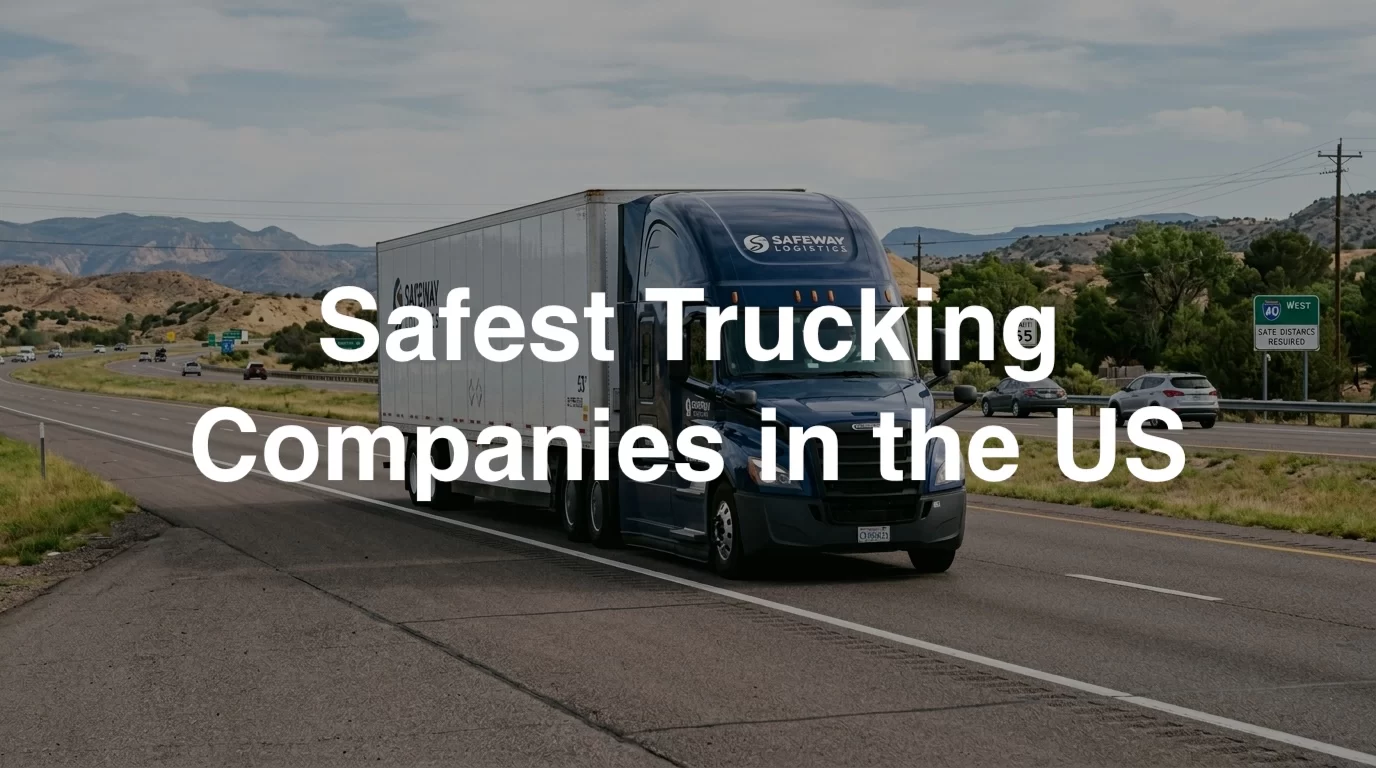
When people search for the safest trucking companies in the US, they are usually looking for reassurance—either as consumers sharing the road with large commercial vehicles or as accident victims trying to understand whether a crash could have been prevented. The reality, however, is more nuanced than a simple ranking. Safety in the trucking industry is not based on brand reputation or company size alone. It is measured through a combination of federal data, operational practices, and driver-level performance.
The trucking industry is regulated by the Federal Motor Carrier Safety Administration (FMCSA), which tracks safety performance across hundreds of thousands of carriers nationwide. Its mission is straightforward: reduce crashes, injuries, and fatalities involving large trucks. To accomplish this, the agency collects extensive data on inspections, violations, and crash history, providing one of the most comprehensive safety monitoring systems in any industry.
How Trucking Safety Is Actually Measured
Unlike consumer industries where reviews and ratings dominate, trucking safety is grounded in regulatory oversight. The FMCSA maintains several databases, including the SAFER System and the Safety Measurement System (SMS), which compile records on every registered motor carrier in the United States.
These systems track a company’s crash history over a rolling period—typically two years—along with roadside inspection results and out-of-service rates. They also assign official safety ratings, such as “Satisfactory,” “Conditional,” or “Unsatisfactory,” based on compliance with federal safety regulations.
A “Satisfactory” rating generally indicates that a company has adequate safety management controls in place. But even this designation requires context. A large national carrier may have more total accidents simply because it operates more trucks and drives more miles. For that reason, regulators and attorneys often focus on accident rates, patterns of violations, and whether a company consistently complies with key safety rules, such as hours-of-service limitations and vehicle maintenance requirements.
The FMCSA itself cautions against drawing sweeping conclusions from a single data point. Safety is a composite picture, not a single metric.
Companies Widely Recognized for Safety
Although there is no official list of the safest trucking companies in the US, several large carriers are consistently recognized for strong safety performance, both through federal data and industry awards. It’s important to note that all but one of these companies (Werner) were also included in our article outlining the largest trucking companies.
Old Dominion Freight Line
Among them is Old Dominion Freight Line, a less-than-truckload carrier that has built a reputation for operational discipline and low accident frequency. The company regularly earns national safety awards and is known for investing heavily in driver training and internal compliance systems.
UPS
UPS is another standout. With one of the most sophisticated driver training programs in the world, UPS emphasizes defensive driving techniques, real-time monitoring, and strict adherence to safety protocols. Its scale is enormous, yet it maintains a relatively strong safety record given the volume of miles driven each year.
FedEx Freight
Similarly, FedEx Freight has developed a robust safety infrastructure built around internal audits and continuous driver education. The company’s focus on compliance and preventative measures has helped it remain competitive not only in logistics but also in safety performance.
Schneider National & Werner
Other notable carriers include Schneider National and Werner Enterprises. Schneider has been a leader in adopting advanced safety technologies, such as collision mitigation systems and lane departure warnings, while Werner is known for its strict hiring standards and emphasis on driver training. Both companies consistently perform well relative to their size.
J.B. Hunt & Knight-Swift
Large carriers like J.B. Hunt Transport Services and Knight-Swift Transportation also deserve mention. While their sheer scale means they inevitably experience accidents, both companies have invested significantly in compliance systems and safety technology in recent years, leading to measurable improvements.
The Reality Behind “Safe” Trucking Companies
It is important to understand that even the safest trucking companies are not accident-free. The United States has more than 400,000 registered trucking companies, and the largest carriers collectively log billions of miles each year. In that context, some level of accidents is statistically inevitable.
What distinguishes safer companies is not the absence of accidents, but how effectively they minimize risk. This includes how they train drivers, maintain their fleets, enforce regulations, and respond to safety violations. A company that quickly addresses issues and enforces accountability is generally safer than one that ignores patterns of noncompliance.
Another critical factor is the variability among drivers. Even within highly regarded companies, individual driver behavior can differ significantly. Fatigue, distraction, and speeding remain leading causes of truck accidents, and these are ultimately human factors that no company can eliminate entirely.
Why Safety Matters in Truck Accident Cases
For attorneys and accident victims, identifying the safest trucking companies in the US is not just an academic exercise—it has direct legal implications. A company’s safety record can provide valuable insight into whether a crash was an isolated incident or part of a broader pattern of negligence.
For example, repeated violations of hours-of-service rules may suggest systemic pressure on drivers to meet unrealistic delivery schedules. Poor maintenance records can indicate a failure to keep vehicles in safe operating condition. In these situations, a company’s safety history becomes a critical piece of evidence in establishing liability.
However, a strong safety reputation does not shield a company from responsibility. Even highly regarded carriers can be liable for negligent hiring, inadequate training, or failure to enforce safety policies. Each case ultimately depends on its specific facts, supported by data from FMCSA databases and other investigative sources.
What Truly Defines a Safe Trucking Company
A genuinely safe trucking company is defined by consistency. It consistently complies with federal regulations, consistently maintains its vehicles, and consistently enforces safety standards among its drivers. It also invests in technology and training not as a marketing tool, but as a core part of its operations.
Companies that prioritize safety tend to view it as a long-term investment rather than a short-term cost. They implement systems to monitor driver behavior, conduct regular audits, and adapt to evolving safety standards. Over time, this approach reduces both accidents and liability exposure.
The Bottom Line
The search for the safest trucking companies in the US leads to a handful of well-known names, including Old Dominion Freight Line, UPS, FedEx Freight, Schneider National, and Werner Enterprises. These companies have earned their reputations through a combination of compliance, training, and operational discipline.
But safety in trucking is not absolute. No company, regardless of size or reputation, is immune from accidents. For accident victims and legal professionals, the most important step is not relying on general rankings, but conducting a detailed, case-specific analysis of a carrier’s safety record.
In the end, trucking safety is not defined by a list—it is defined by data, accountability, and the systems companies put in place to protect everyone on the road.
FAQ
What are the safest trucking companies in the US?
There is no single official ranking, but large carriers with strong compliance records, satisfactory FMCSA ratings, lower violation rates, and strong driver training are often viewed as among the safest trucking companies in the US.
How can I check a trucking company’s safety record?
You can review a trucking company’s public safety history through FMCSA databases, including inspection records, crash history, and safety ratings.
Can a safe trucking company still be responsible for an accident?
Yes. Even companies with strong reputations can still be liable for negligent hiring, poor maintenance, hours-of-service violations, or driver misconduct.
Why does a trucking company’s safety history matter in a truck accident case?
A carrier’s safety record may reveal patterns of violations, maintenance failures, or supervision issues that can help prove negligence.
Sources: