

Trucking accidents are not just larger-scale versions of car accidents—they are governed by different laws, involve different liabilities, and often result in more severe damage and injury. Understanding the critical differences can help victims make informed legal decisions. An experienced truck accident attorney can guide you through the process. For further guidance throughout the process, an experienced accident attorney may be able to help.
Truck Drivers Are Professionally Regulated Operators
Commercial truck drivers are held to stricter licensing and regulatory standards than everyday drivers. They must possess a Georgia commercial driver’s license (CDL) and comply with federal Hours of Service rules set by the Federal Motor Carrier Safety Administration’s (FMCSA). These heightened responsibilities help distinguish truck accident cases from regular car crashes, particularly in terms of liability.
 Semi-Trucks Are Immense
 Semi-Trucks Are Immense
According to the Insurance Institute for Highway Safety (IIHS):
- In 2019, 4,119 people died in crashes involving large trucks.
- 16% of those deaths were truck occupants; 67% were occupants of passenger vehicles.
- Fatal truck crashes have increased by over 30% since 2009.
Large trucks were involved in 11% of all fatal crashes that year.
The immense size of 18-wheelers, therefore, is a prime example of how trucking accidents differ from car accidents.
Trucks Require Longer Stopping Distances
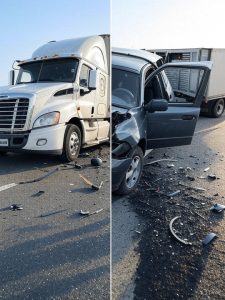 The massive weight behind the semi-trucks on our roads means that they require much longer stopping distances than the lighter passenger vehicles require. Because of their weight and momentum, trucks require significantly more time and distance to stop—especially in adverse conditions like rain, traffic congestion, or construction zones. Speeding or failing to adjust for these conditions increases thrisk of a rear-end collision or runaway truck incident.
Trucks Have Serious Blind Spots
Trucks have large blind spots on all four sides—especially along the sides and rear. Smaller vehicles that linger in these areas may be completely invisible to the truck driver. These blind spots are a leading cause of merging and lane-change collisions involving commercial vehicles. One blind spot is located at the semi’s front, so when truckers approach too closely to vehicles ahead of them, they significantly increase the risks inherent to tailgating. The large blind spots along the left and right sides of tractor-trailers render any vehicles in those areas invisible to truckers, and they are often the impetus behind life-threatening traffic accidents when truckers fail to pay adequate attention to surrounded traffic.
The Trucking Company May Play a Role
When a driver has a car accident claim, the other motorist’s negligence is often identified as the cause. Truck driver negligence does often play the starring role in truck accident claims. In many cases, fault lies not only with the truck driver but also with the trucking company. Companies may be held liable for:
- Negligent hiring or training of drivers
- Failure to maintain vehicles
- Unsafe scheduling or dispatch practices
- Violation of hours-of-service rules
- Poor enforcement of safety protocols
Losses Suffered from a Trucking Accident
Overall, a wide range of distinctions determine how trucking accidents differ from car accidents, and each of them can be very serious. In fact, a final difference that distinguishes these accidents is the extent of the losses, or legal damages, that victims of these accidents are likely to face.Due to the scale of a truck accident, victims often experience far greater losses than in a typical car crash. These may include:
- Long-term or catastrophic medical treatment
- Inability to return to work
- Chronic pain, trauma, and reduced quality of life
A focused and experienced Georgia truck accident attorney will know more about how trucking accidents differ from car accidents and can help with a personal injury claim.