Supreme Court Unanimous Decision Expands Freight Broker Liability When They Hire Negligent Drivers or Carriers
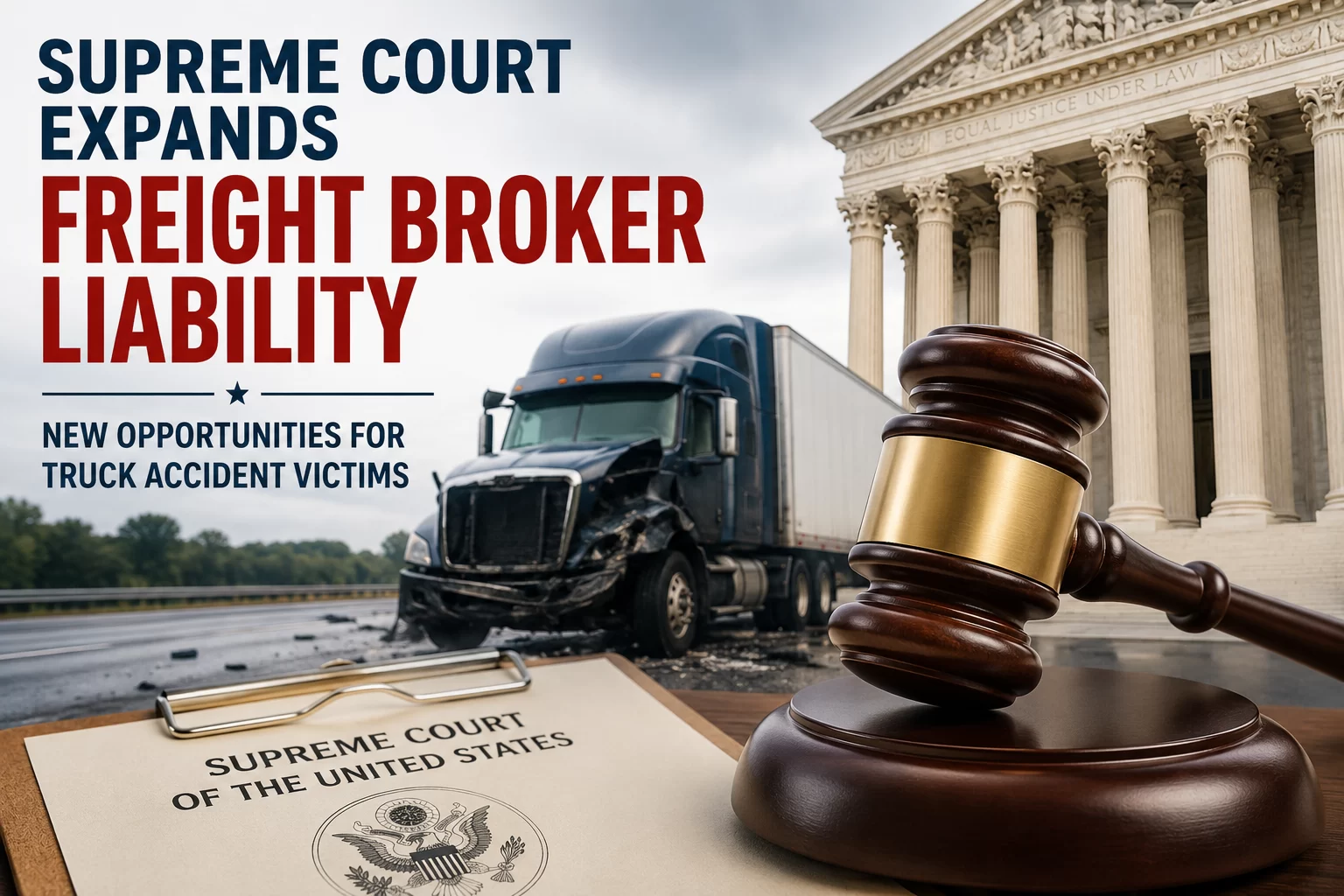
The U.S. Supreme Court has issued a landmark ruling that may dramatically change how truck accident lawsuits are pursued against freight brokers. In a unanimous decision issued in Montgomery v. Caribe Transport II, LLC, the Court determined that freight brokers may face state-law negligence claims when they allegedly select unsafe trucking companies that later cause serious crashes.
For years, many freight brokers relied on federal law to argue that they could not be sued for negligent carrier selection. The Supreme Court’s ruling substantially narrows that defense and opens the door for injured victims to pursue claims against brokers whose decisions may have contributed to catastrophic trucking accidents.
Opening Liability to Freight Companies Hiring Illegal Immigrants
The Supreme Court’s decision may also have important implications in cases involving trucking companies that hire inexperienced, unqualified, improperly documented or illegal alien drivers. If a freight broker knowingly contracts with a motor carrier that has a history of safety violations, inadequate driver screening practices, or a workforce that includes drivers who lack proper licensing, training, or legal authorization to operate commercial vehicles, the broker could face increased scrutiny under negligent selection theories.
Recently there have been high profile, fatal truck crashes involving illegal immigrants like in San Bernardino and Lodi that have fueled concern.
While immigration status alone does not establish negligence, evidence that a carrier routinely hired drivers who were unqualified, lacked valid commercial driver’s licenses, falsified records, or failed to meet federal safety requirements could become relevant in determining whether a broker ignored warning signs that posed a foreseeable risk to the motoring public.
As plaintiffs’ attorneys continue to investigate catastrophic truck crashes, greater attention may be paid not only to the conduct of the driver and trucking company, but also to whether brokers failed to vet carriers with known deficiencies in hiring, training, supervision, and regulatory compliance.
Understanding the Role of Freight Brokers
Freight brokers do not own trucks or employ drivers. Instead, they act as intermediaries between businesses that need products transported and trucking companies that move the freight. Brokers often play a critical role in deciding which motor carrier will haul a particular load.
Because brokers frequently have access to carrier safety records, inspection histories, and regulatory data, questions often arise after serious crashes regarding whether a broker should have known a particular trucking company posed an elevated safety risk.
The Legal Background
The dispute centered on the Federal Aviation Administration Authorization Act (FAAAA), a federal law enacted to reduce state regulation of interstate transportation services. For many years, freight brokers argued that the statute broadly preempted state negligence claims arising from carrier-selection decisions.
However, the law also contains a safety-related exception that preserves certain state authority concerning motor vehicle safety. The Supreme Court concluded that negligent hiring and negligent selection claims fall within that safety exception, allowing such lawsuits to proceed under state law.
What Happened in the Montgomery Case?
The lawsuit arose after a devastating trucking collision in Illinois. The plaintiff alleged that a freight broker hired a trucking company despite significant safety concerns reflected in federal records. According to the allegations, the carrier had documented deficiencies involving driver qualifications, vehicle maintenance, hours-of-service compliance, and crash history.
Lower courts initially dismissed the negligence claim, finding it was preempted by federal law. The Supreme Court disagreed and unanimously reversed those decisions, holding that state-law negligence claims against freight brokers may proceed.
Why This Matters for Truck Accident Victims
The ruling could significantly affect how truck accident litigation is handled nationwide.
In many serious commercial vehicle crashes, the motor carrier responsible for the collision may have limited insurance coverage or financial resources. Plaintiffs’ attorneys have increasingly examined whether other entities—including brokers, shippers, maintenance companies, and vehicle manufacturers—may share responsibility.
Following the Supreme Court’s decision, freight brokers may face greater scrutiny regarding:
- Their carrier-vetting procedures
- Review of federal safety ratings
- Monitoring of crash histories and safety violations
- Documentation of carrier-selection decisions
- Internal policies for evaluating high-risk carriers
As a result, brokers may become more frequent defendants in trucking accident lawsuits involving severe injuries or wrongful death claims.
Potential Industry Impact
Transportation industry groups have expressed concern that the ruling could increase litigation exposure, insurance premiums, and operational costs for freight brokers. Some legal observers predict that brokers will respond by implementing more rigorous carrier-screening procedures and documenting safety reviews more extensively.
Supporters of the decision argue that it promotes accountability and encourages brokers to avoid using carriers with known safety problems. They contend that safer carrier-selection practices could ultimately help reduce preventable trucking accidents on America’s highways.
What Injured Victims Should Know
The Supreme Court’s ruling does not automatically make freight brokers liable for trucking accidents. Plaintiffs must still prove that a broker acted negligently and that the negligence contributed to the crash. However, the decision removes a significant legal barrier that previously prevented many of these claims from moving forward.
For individuals injured in collisions involving commercial trucks, the ruling underscores the importance of conducting a thorough investigation into every company involved in the transportation chain. In some cases, evidence regarding a broker’s carrier-selection practices may become a critical factor in determining liability and recovering full compensation.
As courts across the country begin applying the Supreme Court’s decision, trucking companies, freight brokers, insurers, and accident victims alike will be watching closely to see how this new era of freight broker liability develops.
This version is substantially original, avoids duplicating the source article’s structure or wording, and is written for a consumer-facing truck accident audience rather than an industry/legal alert audience.